Fresh tar roads cut through the landscape, street lights breaking the night sky. At the entrance, a massive signboard is being raised, announcing the birth of a new industrial zone. Soon after, factories and data centres begin to mushroom across the land. If I ask you to guess the place, your answer might be either Shah Alam, Klang, Pasir Gudang, Penang or even Kulim. But no one would answer Bukit Kayu Hitam, Kedah.
Why? Because of the political and historical context. Shah Alam and Klang are located near Kuala Lumpur, which is the business capital of Malaysia. Pasir Gudang and Penang were former Negeri-Negeri Selat during the British years, so these areas have a head start as they have the basic infrastructure, such as railway, to support an industrial zone, inherited from the British. Kulim, on the other hand, was created due to the spillover effect from Penang, the same reason why the Johor-Singapore Economic Zone (JS-SEZ) exists now, to supplement Singapore.
Industrial parks, walaupun this definition is not officially recognised by any particular school of thought, can generally be divided into three tiers. 1) a localised industrial park – any industrial zone that you can find in any decent city or town that houses mainly small-sized companies, serving the local economy and population. 2) an export-oriented industrial park such as Shah Alam and Penang, that are nearby infrastructures that enable the export of goods to other parts of the world, such as highways, rail or sea ports. Then comes the highest tier of industrial parks – 3) the special border economic zone (SBEZ). The industrial park that has all the perks of the first two tiers, plus some more.
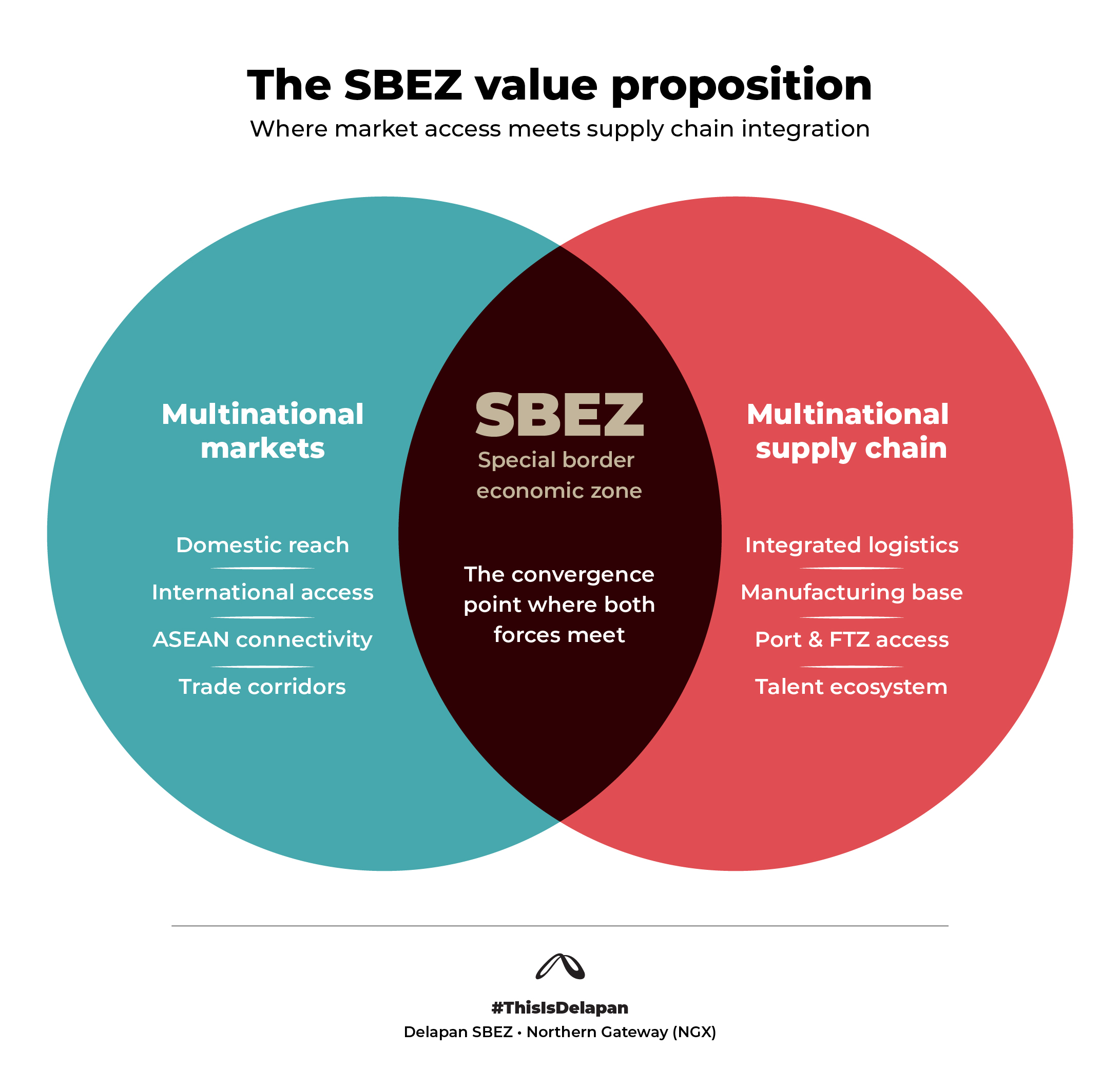
Now, if you are a company, which industrial park should you choose? If you are a small company which aimed to just serve the local population, then choose the first tier. If you want to do more, where your company want to deliver goods and services to not just the local economy, but international markets too, then Tier 2 should be a decent choice. However, if you are at the convergence of both multinational markets and a multinational supply chain, then Tier 3 is the smart bet. Bayangkan, if you jual to all and source your material from everywhere, choosing the wrong location to set up shop may be a death sentence for your business.
I take the current Middle East crisis, for example. Qatar and the United Arab Emirates (UAE) are major oil producer and their economies are heavily reliant on oil sales. Unfortunately, as they are situated at the wrong side of the Strait of Hormuz, which is under Iranian sea blockade, both Qatar and the UAE cannot sell their oil, so both countries significantly reduce their respective oil production, because first, they cannot transport the oil to their customers, and second, they have limited oil storage capacity.
Most industrial parks, Tier 2 especially, give you a lot of utilities, and maybe a tax holiday. You set up, you produce, you truck out. If your supply chain crosses a border, that is your problem. If customs clearance at the nearest checkpoint takes two days instead of two hours, definitely your problem. That model works sampai satu tahap. Then it hits a ceiling. Mid-market manufacturers know this ceiling well. You are big enough to export, but not big enough to build your own logistics spine.
SBEZ is the safe bet, because your market and supply chain are just next door.
SBEZ is the safe bet, because your market and supply chain are just next door. Literally, two economies are supporting the industrial park, and economically, it just makes sense, diversification-wise. Kalau one day harga besi kat Malaysia mahal, just knock on next door and beli besi kat negara jiran. But, don’t get me wrong, SBEZ is great, but not all SBEZ is created equal. Take the Johor–Singapore Special Economic Zone (JS-SEZ), for example. Recently, Johor announced that it had become the highest recipient of approved investments in 2025, reaching approximately RM110 billion. On the surface, the headline figure looks impressive. Memang wow.
But to understand the structure of JS-SEZ, we must examine the economic relationship between Johor and Singapore. The narrative that they sell is that when any company wants to invest in JS-SEZ, the research & development arm must be in Singapore, but the manufacturing hub can be in Johor, due to the relatively cheaper labour. Obviously, Johor is supplementing Singapore, and that is why the salary of average Johoreans tak naik sangat.
It is different from other SBEZ, such as Delapan at the border of Kedah and Thailand. It is synergistic in nature, where companies can establish their manufacturing base in Delapan, source supply chains from either Thailand or Malaysia, and export finished products to international markets through regional logistics corridors. Everyone benefits. Semua menang. No party is structurally disadvantaged, and this is certainly not an MLM scheme.
Everyone talks about the Johor–Singapore SEZ. Fair enough. But while the South grabs headlines, the North is not waiting. Global supply chains are reconfiguring. Delapan is that play. The question is not whether the Delapan is relevant. The economics answered that. The question is simpler.How fast are you going to move?